GET FIRE READY BLOG
Why Excavator Clearing Beats a Chainsaw and Trailer for Serious Fire Fuel Removal
Professional land clearing services match chainsaw capabilities for serious fuel loads. Learn why excavator clearing meets CFA standards faster.
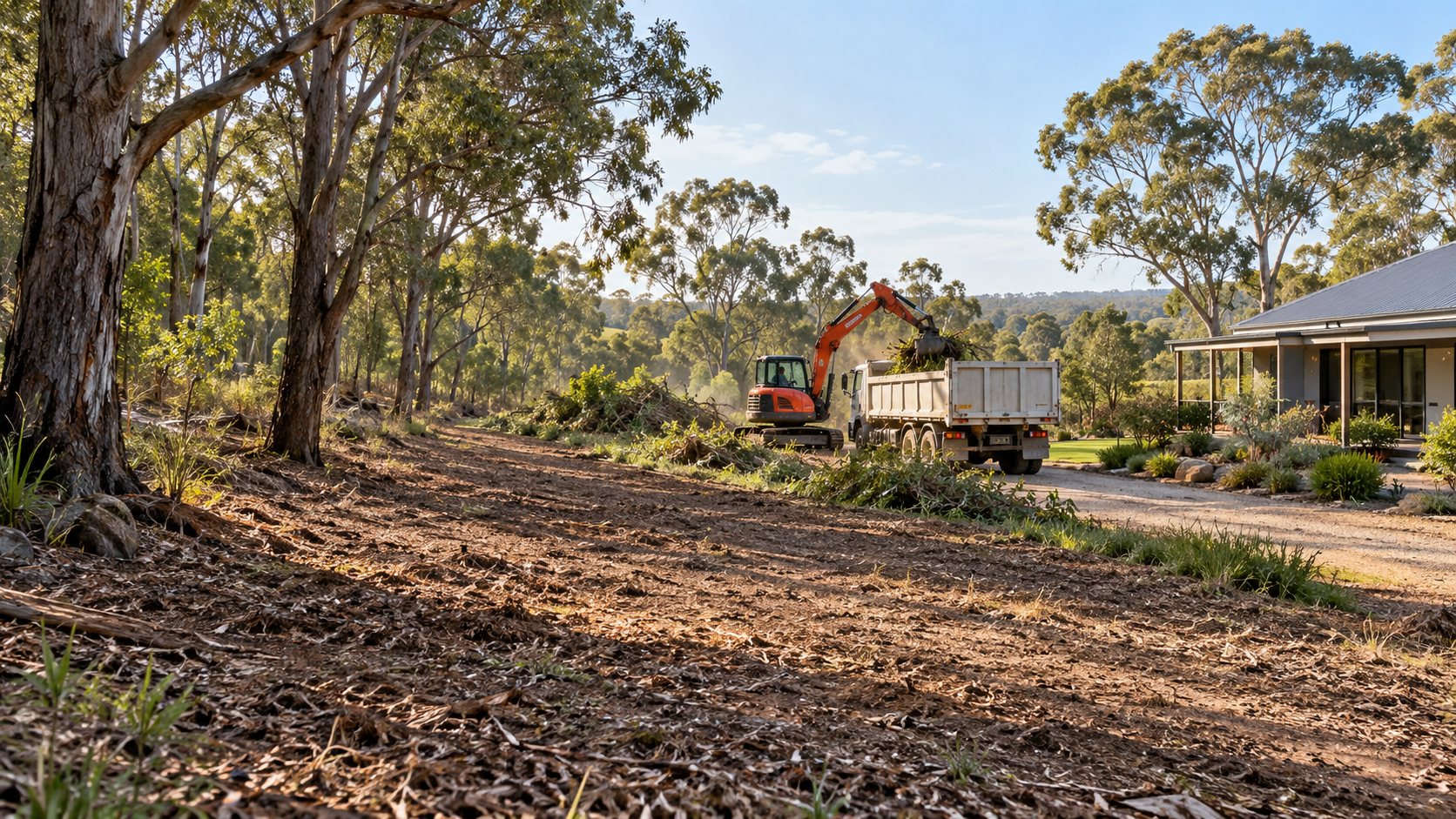
There is a point on every heavily timbered rural block where a chainsaw and a trailer stop being tools and start being obstacles. When undergrowth has compounded over decades, fallen timber has accumulated across multiple seasons, and shrub density has reached the threshold that concerns your local fire authority, the question is no longer whether you can clear the land yourself. The question is whether you can clear it fast enough, thoroughly enough, and safely enough to meet the standards that actually matter.
This is the capability gap that professional land clearing services exist to fill. A tracked excavator with purpose-built attachments can achieve in weeks what manual methods cannot achieve in a season, and it can do so while reducing the operational fire risk created by the clearing work itself.
If you are a rural property owner weighing your options against a serious fuel load, this post works through the full comparison. You will find what CFA standards actually require, why mechanical clearing outperforms manual methods at scale, where the terrain and timeline pressures become decisive, and what to raise with a contractor before committing to an approach.
The Scale Problem Manual Clearing Cannot Solve
Rural blocks carrying dense undergrowth, accumulated fallen timber, and layered shrub growth present a volume problem, not just a tidiness problem. A chainsaw and trailer can address isolated patches, but when fuel load is distributed across five, ten, or fifty hectares, the arithmetic of manual clearing simply does not work within a single fire season preparation window.
The scale constraint is not a matter of effort. The 2009 Victorian Bushfires Royal Commission confirmed that government-managed prescribed burning across 7.7 million hectares of public land was "insufficient to significantly reduce the risk of bushfires," describing the work as resource-intensive and available only in limited time frames. If coordinated, professionally resourced state programs cannot outrun the scale constraint, a manual crew on a private block faces the same ceiling at a fraction of the capacity.
The operational gap between methods compounds quickly. A chainsaw operator works linearly: clear a section, haul the cut material, return, repeat. An excavator fitted with a mulching or raking attachment covers ground in parallel passes, processing vegetation in place. There are no load-haul-disposal cycles to interrupt progress. The machine moves through the site continuously, and the cleared corridor widens with each pass.
For blocks in the 5 to 50 hectare range, this difference is not marginal. It is the difference between a partially reduced fuel load and a completed job before summer arrives. Manual clearing also creates a structural bottleneck: in thick scrub, the clearing work and the removal work compete for the same ground simultaneously, slowing both. Excavator-based undergrowth and fuel load clearing removes that bottleneck entirely, keeping access open throughout the site as the work progresses.
What CFA Standards Actually Require From Your Clearing Work
Volume alone is not the only barrier manual clearing fails to clear. The regulatory standard you are working toward defines what must be achieved, and it is more precise than most property owners realise.
The CFA Bushfire Fuel Management Guide establishes four distinct zones across your property: the Asset Protection Zone (APZ), Bushfire Moderation Zone (BMZ), Landscape Management Zone (LMZ), and Fuel Management Exclusion Zone (FMEZ). Each zone carries different clearing intensity requirements. These are not aesthetic guidelines; they define specific modifications to vegetation structure, fuel hazard rating, and canopy separation that must be achieved and maintained.
The APZ, the zone immediately surrounding your home, carries the most demanding requirements. The CFA guide describes the target as highly modified vegetation, such as a cultivated garden or grassland, with overall fuel hazard reduced to moderate levels. Manual effort can meet this standard in a courtyard. Across a full defendable space perimeter on a rural block, maintaining that standard is a different problem entirely.
Fuel breaks carry a second function that is easy to overlook. Beyond reducing fire intensity, they must provide physical access corridors for suppression crews and tankers moving through the landscape. A partially cleared line that a chainsaw crew has worked through may reduce some fuel; it does not provide a trafficable corridor for a fire truck. That distinction matters operationally.
The legislative recognition of this standard extends beyond Victoria. Victoria's CFA zone framework establishes this standard; equivalent frameworks operate in Queensland and NSW, where fire management is also recognised as a legitimate clearing purpose. The underlying expectation is consistent: this work is systematic, not opportunistic.
Property owners who clear with a chainsaw and a trailer often discover they have tidied the property without moving the needle on the metrics that determine compliance: canopy gap, shrub density, and ground fuel continuity. Explore undergrowth and fuel load clearing carried out to these standards to understand what compliant clearing actually looks like in practice.
The Capability Case for Excavator Land Clearing at Serious Fuel Loads
Meeting those zone standards requires more than intent; it requires the right equipment for the actual material on the ground.
A tracked excavator fitted with a mulching head, clearing rake, or rock bucket handles mixed material in a single operational pass. Standing scrub, fallen timber, root masses, and rocky ground that would force a chainsaw operator to stop, reposition, and reload a trailer are processed continuously by the machine as it moves through the site. That difference in workflow is what makes serious vegetation clearing achievable within a single preparation season.
The mulch-in-place advantage is also a fire safety outcome. Land clearing equipment at this scale processes and deposits material on-site at low depth. Mulched ground cover does not carry fire the way standing scrub or a stockpiled trailer load does. A pile of cut vegetation waiting for a green waste run is a concentrated fuel source sitting on your property; mulched material laid flat is not.
Access corridors are created as a direct byproduct of the work. Access corridors created by excavator clearing are substantially wider than what a chainsaw crew can systematically maintain across a full clearing line, a practical requirement when suppression crews need trafficable routes.
Dense undergrowth, significant fallen timber, and shrub-dominated regrowth also present genuine personal safety risks for a solo chainsaw operator working in dry conditions. Falling hazards, fatigue, and ignition risk combine in ways that are absent when the operator is seated in an enclosed, protected cab. If your property also has earthworks or access track requirements alongside the clearing, Need Excavation or Earthworks? outlines how that scope can be handled within the same engagement.
Professional land clearing services deliver a documented outcome, not just a reduced visual clutter. That documentation matters when responding to a council notice or demonstrating CFA compliance; it is the difference between evidence of completed work and a best-effort that cannot be verified.
Operational Fire Risk During the Clearing Work Itself
The capability difference between a chainsaw and an excavator does not stop at what each method can clear. It extends to the risk each method introduces while the work is happening.
Petrol-powered cutting chains running at high RPM through dry timber generate heat at the contact point, a risk that hydraulic mulching attachments do not introduce. Petrol-powered equipment operating in cured vegetation during peak clearing season introduces ignition risk that is absent from hydraulic attachments.
Manual work compounds this exposure in a second way. Fatigue accumulates quickly in dense scrub, particularly in heat. A fatigued operator registers changed conditions later, moves more slowly, and has fewer exit options when surrounded by the thick vegetation they are clearing. A fire that starts at the work site while someone is deep in undergrowth with a running saw is a personal emergency with very little margin.
An excavator removes both of these vectors. The hydraulic attachments that process vegetation generate no open flame and none of the sustained friction heat produced by a petrol cutting chain. The operator is seated in an enclosed cab, with full visibility and an immediate escape route if conditions deteriorate.
The timing advantage reinforces the safety case. Excavator clearing covers ground fast enough that serious bushfire fuel preparation can be completed earlier in the season, before ambient temperatures and fuel dryness reach their peak. A manual crew that falls behind schedule extends into higher-risk conditions by necessity.
On-site mulching resolves the green waste problem simultaneously. Cut vegetation stockpiled near a property is a concentrated fuel load; mulching attachments process material in place, eliminating that secondary risk before it can accumulate.
Where Manual Methods Still Have a Role
None of this means excavator clearing is the universal answer for every metre of your property.
Machines have physical limits. A tracked excavator cannot operate safely on slopes beyond safe machine operating limits, in areas with wetland constraints, or in confined spaces directly adjacent to structures where access is physically impossible. In those zones, manual effort or compact equipment remains the only workable option, and a competent contractor will identify those areas during the initial site walk rather than forcing a machine where it does not belong.
There is also a genuine role for manual work in the maintenance phase that follows initial mechanical clearing. Once a machine has stripped a block to CFA-standard fuel loads, keeping it there year to year is a different task. Trimming new growth, removing seasonal litter accumulation, and managing isolated regrowth are suited to scheduled manual effort. That is not a concession; it is simply how a two-phase programme works.
The capability argument in this article is also not directed at small residential blocks or urban-interface properties where fuel accumulation is modest and block size is limited. Those properties rarely carry the fuel load or present the timeline problem that mechanical clearing solves. The case for excavator-scale land clearing services applies specifically where fuel load, block size, and terrain combine to exceed what manual methods can achieve before the season.
FireReady's service range reflects this boundary directly. Excavator clearing and fire break creation address serious fuel situations; garden clean-ups, hedge trimming, green waste removal, and related earthworks support the ongoing maintenance work that follows. Matching the method to the actual condition on your block is what converts effort into measurable fire preparation, rather than activity that misses the mark in either direction.
Timeline, Terrain, and Compliance: What to Raise at a Site Assessment
Once you have matched the right method to your block, the next step is converting that understanding into a scoped, documented plan. That conversion happens at a site assessment, not online.
Pricing cannot be quoted accurately without a site visit. Per-hectare rates and day-rate estimates for excavator land clearing shift considerably depending on vegetation density, terrain difficulty, and whether material will be mulched in place or requires removal. A contractor quoting blind is guessing. A site assessment gives you a realistic picture of what single-season completion actually requires for your specific conditions.
Terrain shapes both the machine selection and the clearing sequence. Rock outcrops, drainage lines, and proximity to structures each introduce constraints that change the plan. An experienced land clearing contractor will walk the block before quoting and flag any zones where mechanical access is limited and manual follow-up work will be needed alongside the excavator. That walk is not a formality; it is where the job gets scoped honestly.
Compliance documentation is worth raising directly. Ask whether the contractor's work will be recorded in a form that supports a council or CFA response if one arrives. Post-clearing inspection and certification options vary by local area, so ask what exists in yours rather than assuming your contractor will raise it unprompted.
Insurance and accreditation are non-negotiable checkpoints. Before engaging any land clearing service for fire preparation work, confirm the operator carries appropriate public liability coverage and that the machinery is maintained and registered for commercial clearing operations. These are straightforward questions with straightforward answers from any credible contractor.
The gaps that web guides cannot fill, including real pricing, post-clearing certification pathways, and insurance verification, are precisely what a site conversation with a qualified contractor resolves. The answers live in the property and the machinery, not in a search result.
Making the Right Call for Your Block
Once the site assessment conversation is done and the scope is clear, the decision itself is straightforward.
If your fuel load, block size, or timeline means manual clearing cannot finish the job before the season opens, professional excavator clearing is not a premium upgrade. It is the only practical option available to you. The regulatory record established in earlier sections converges on the same conclusion. The safety case from the Operational Fire Risk section stands independently.
What varies is how that conclusion applies to your specific block, your vegetation density, your terrain, and your compliance deadline.
A site assessment turns the general capability argument into a specific plan. That is where timeline, terrain constraints, and compliance outcomes get answered for your property rather than for rural blocks in general. Contact FireReady to arrange an assessment before the season forecloses your options.
Conclusion
Serious fire fuel removal is not a task where effort substitutes for capability. The capability and safety case is established: at serious fuel loads, mechanical clearing is not a premium choice, it is the practical one.
The right method depends on your block, your vegetation density, your terrain, and your deadline.
Every season closed without action narrows your options. A site assessment converts the general case into a specific plan for your land. Contact FireReady today and go into this season with a clear, compliant, and executable fuel management strategy.