GET FIRE READY BLOG
What Is Bushfire Property Preparation and Why Central Victoria Properties Need It Before Fire Season
Learn what professional bushfire property preparation involves and why it matters for Central Victoria and Hepburn Shire properties before fire season.
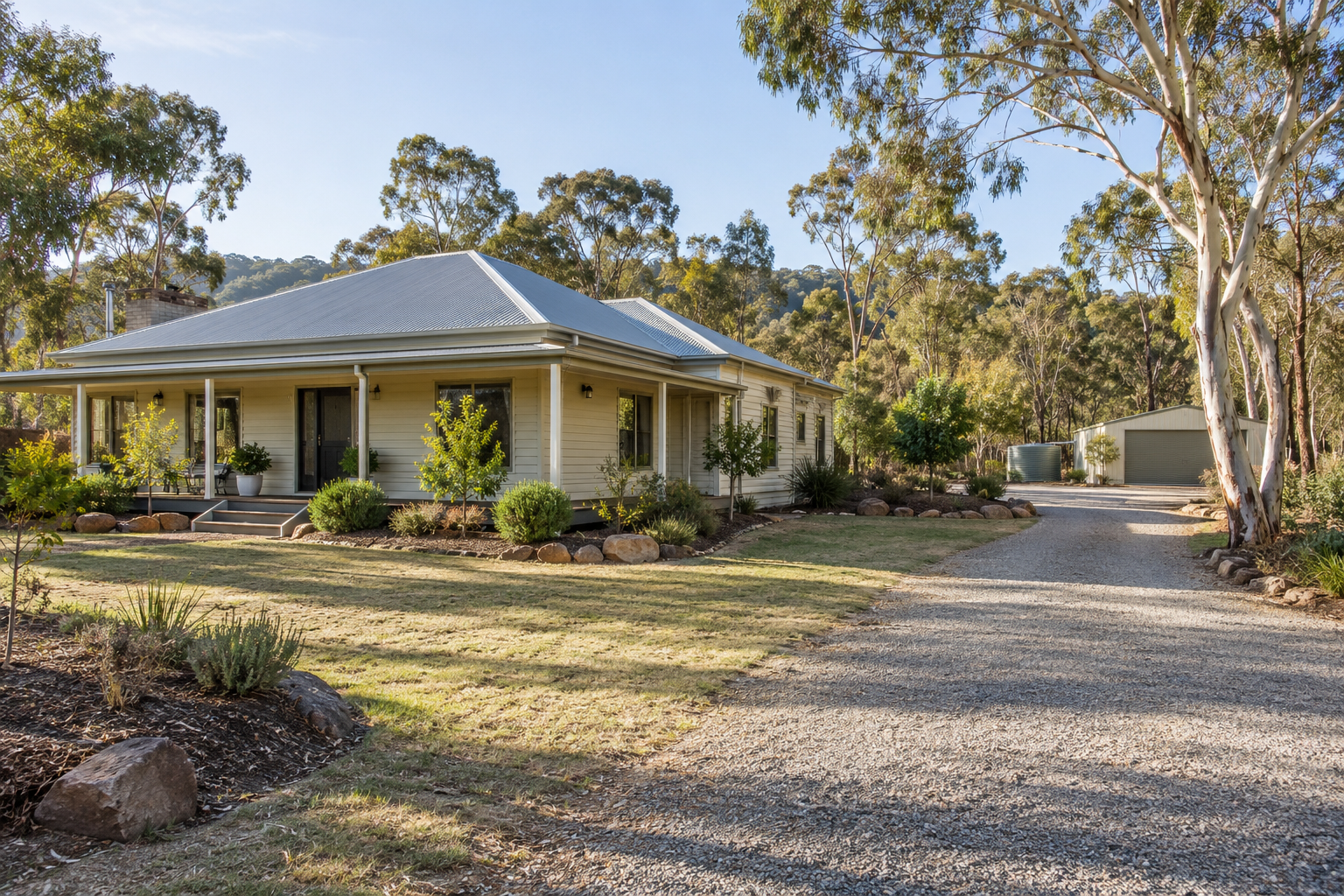
Every year, as summer approaches and the grass turns golden across Central Victoria, thousands of property owners face the same urgent question: is my home actually ready for fire season? For those living in Hepburn Shire and the surrounding high-risk zones, that question carries serious weight.
Bushfire property preparation is not a single afternoon of clearing gutters or mowing grass. It is a structured, multi-step programme built around three integrated pillars: fuel reduction, defendable space creation, and structural hardening. Each component works together to give a property a genuine fighting chance when fire threatens.
This guide explains what professional bushfire preparation actually involves, starting with why Central Victoria faces a distinct level of risk. You will learn what defendable space means, how it is measured, and how it is created around your property. You will also discover why timing matters, what the Country Fire Authority recommends, and why professional preparation delivers results that a weekend clean-up simply cannot match. Whether you own a rural block or a residential property on the urban fringe, this post gives you the foundation you need to prepare with confidence before fire season arrives.
Why Central Victoria Properties Face a Distinct Bushfire Risk
Hepburn Shire and the surrounding Central Fire District sit within one of Victoria's formally recognised high fire-risk zones. Dry summers, elevated terrain, and dense native vegetation combine each season to create conditions where fire can establish, intensify, and travel quickly. The CFA's Central Fire District framework responds to this by issuing fire danger ratings across four levels, from Moderate through to Catastrophic, and enforcing total fire bans that directly affect what property owners can and cannot do each summer.
Rural and semi-rural properties carry particular exposure. Larger block sizes mean more fuel load to manage. Proximity to bushland creates continuous vegetation corridors that fire can travel along. Limited road access affects how quickly any response can reach a property once a fire is moving.
The risk is easy to underestimate on a still, overcast day. A block that looks manageable in those conditions is a different proposition entirely under fire weather. Steep slope accelerates fire spread dramatically. Dense dry scrub generates radiant heat that can ignite a structure before flames arrive. Prevailing wind direction determines which side of the property bears the greatest pressure, and that calculation changes with every fire event.
The most important distinction for rural property owners is this: unlike urban homes, properties in Central Victoria cannot count on a rapid brigade response when a fire front is active. Local to Hepburn Shire and Central Victoria, Victoria's own bushfire risk management framework confirms that individuals and households play a critical part in reducing their own risk. When a fire is approaching, property-level preparation is the primary line of defence.
What Bushfire Property Preparation Actually Means
Given that risk, understanding what genuine preparation actually involves is the necessary first step.
FireReady structures preparation around three integrated components:
Fuel reduction: removing or reducing flammable vegetation, leaf litter, dry grass, and accumulated debris that feed a fire's intensity
Defendable space creation: establishing a managed buffer zone between combustible vegetation and the structure, so a fire front loses momentum before it reaches the building
Structural hardening: protecting the building elements most vulnerable to ember attack and radiant heat, including gutters, vents, eaves, and gaps in the roofline
Each component reinforces the others, a gap in any one reduces the programme's overall effectiveness.
The CFA's property preparation guidance reflects this same multi-component logic, treating preparation as a structured programme rather than a list of isolated jobs to tick off.
Preparation also differs fundamentally from routine garden maintenance. Every decision in a genuine preparation programme is made with fire behaviour in mind. Which shrubs to remove, how far back to clear, which structural gaps to seal: these are not aesthetic judgements. They are risk-based decisions that require a different intent and a different scope entirely.
Fuel Reduction: The Foundation of Fire Preparation
Fuel load is the starting point for everything else. It refers to the total volume of combustible material on a property: dry grass, leaf litter, fallen branches, dense shrubs, and accumulated organic debris. The higher the fuel load, the more intensely and rapidly a fire burns. Reducing that load is the first and most consequential task.
Vegetation clearing and land clearing are the primary tools. This means removing dead plant material, cutting back overgrown shrubs and grasses, and clearing debris from around structures and along access tracks. Each of these actions directly reduces the energy available to an approaching fire front.
On rural properties across Hepburn Shire and surrounds, manual clearing is often not enough. Established undergrowth, deep root systems, and steep terrain make excavator-assisted clearing a practical necessity rather than an upgrade. Undergrowth and fuel load clearing using machinery covers ground that hand tools simply cannot manage at the scale these properties require.
One step that is frequently missed: green waste removal. Cutting back vegetation and leaving the debris on-site does not reduce the fuel load, it just moves it. Piled cuttings dry out quickly and become loose, highly ignitable material sitting directly around the property.
Timing is equally important. Clearing completed well before the CFA's fire danger period begins allows cut material to be removed before it dries out. Clearing done too close to the season's start leaves that dry debris in place exactly when conditions are most dangerous.
Defendable Space: What It Is and How It Is Created
Fuel reduction clears the fuel load across the broader property. Defendable space takes that logic one step further, focusing specifically on the zone immediately surrounding a structure.
Defendable space is the managed area around a building where vegetation has been reduced or modified so that firefighters, or residents who have chosen to stay and defend, can operate safely when a fire front arrives. It is not simply a cleared yard. Research published in the Australian Journal of Emergency Management and hosted by the Australian Disaster Resilience Knowledge Hub, drawing on the Wye River-Separation Creek fire, establishes defendable space as a formally studied, evidence-based mitigation strategy with measurable outcomes, not a general precaution.
Creating it involves several distinct tasks: garden clearing, selective removal of trees and shrubs within a defined radius, and low-level pruning of retained trees to eliminate ladder fuels. Ladder fuels are low branches and shrubs that allow ground-level fire to climb into the canopy. Remaining vegetation must be well-separated, breaking the continuity that lets fire travel uninterrupted toward the building. Professional lawn and firebreak management is central to establishing and maintaining this buffer, and it must be revisited each season as vegetation regrows.
The required size of the buffer is not fixed. Slope, vegetation type, and building construction all determine the appropriate radius. A property on a slope surrounded by dense dry scrub needs a substantially larger buffer than a flat, well-maintained block. A professional assessment matches the defendable space specification to the actual conditions of the site.
Structural Hardening: Protecting the Building Itself
Clearing the land around your home reduces the fire's reach, but embers travel far beyond any clearing. CSIRO research confirms that the majority of houses lost in Australian bushfires are not destroyed by direct flame contact; they are ignited by ember attack. Wind-carried embers enter through gaps in gutters, vents, eaves, and roof junctions, then ignite debris inside the roof cavity or on the deck. Preventing that ingress is the focus of structural hardening.
Gutter cleaning is the single highest-impact starting point. Gutters filled with dry leaf litter and debris become a ready ignition bed the moment an ember lands. This task must be completed immediately before fire season, not months earlier, because gutters reaccumulate debris quickly and the window of protection is narrow.
Exterior bushfire sprinkler systems add a layer of active protection by wetting the roof and exterior walls during an ember shower, reducing both ignition potential and radiant heat load on the building. This is particularly valuable when residents have evacuated and the property must, in effect, defend itself. FireReady installs exterior sprinkler systems sized and positioned for your property's specific exposure.
Beyond gutters and sprinklers, structural hardening includes sealing gaps in eaves and roof junctions, fitting fine ember-resistant mesh over vents, and relocating any combustible materials stored against exterior walls.
Structural hardening and fuel reduction work as a pair, neither is sufficient without the other.
Why Professional Preparation Differs From a Weekend Clean-Up
Knowing what to protect is only useful if the preparation work itself is done to the right standard.
A weekend clean-up removes what is visible: fallen branches, overgrown edges, accumulated rubbish. What it rarely addresses is the full fuel load across the block, the structural gaps that create ember entry points, or the strategic question of where vegetation is removed relative to how fire is likely to approach the property.
Professional preparation applies fire behaviour knowledge to every decision. Which trees are retained and which are removed, where firebreaks are positioned along the property boundary, how far back vegetation must be cleared on a sloped block, and which structural gaps carry the highest ignition risk all require trained assessment, not visual judgment on a calm day.
On rural properties, machinery access is a practical dividing line. Excavator clearing of established undergrowth, fire break creation, and earthworks for ongoing firebreak maintenance require equipment that most property owners cannot access or operate safely. This is work that cannot be approximated with hand tools or a weekend's effort, particularly on the steeper, denser blocks common across Hepburn Shire.
Professional assessment also surfaces risks that are genuinely non-obvious: ladder fuels in retained trees, minor roofline gaps that become ember pathways, and vegetation patterns that would direct fire toward a structure under local wind conditions.
The CFA's free guidance is a sound framework. It describes what a prepared property looks like. Professional fire preparation services translate that framework into physical work, completed at scale, to a standard that provides real protection.
When Preparation Must Happen: Seasonal Windows in Central Victoria
Knowing what preparation involves is only useful if it happens at the right time.
Victoria's CFA declares a formal Fire Danger Period for each municipality annually, typically beginning as early as October in higher-risk areas and extending through to late autumn. For properties in Central Victoria's Central Fire District, this window defines when fire risk is at its peak and, critically, when your options narrow. Once the Fire Danger Period is declared, open burning requires a permit or is prohibited outright. On Total Fire Ban days, most clearing and burning activities stop entirely. The time to prepare is not October. By October, the window is closing.
The optimal preparation window is late summer through to early spring. This timing works because the previous fire season has ended, conditions are cooler, and clearing can be completed and disposed of before peak fire weather arrives.
Gutter cleaning is the exception, best completed immediately before fire season rather than months ahead, but all vegetation clearing, land clearing, and fire-ready property works should be substantially complete well before the danger period begins.
Preparation is also not a one-off event. Vegetation regrows, debris accumulates, and structural protection degrades over time. An annual cycle, repeated each year, is the standard that gives a property a genuine, consistent chance.
Booking early in the preparation window ensures work can be completed methodically rather than under pressure as the season approaches.
Preparation as a Shared Responsibility in Hepburn Shire
Timing is only part of the equation. Who takes responsibility matters just as much as when.
Hepburn Shire Council has explicitly positioned bushfire preparation as a shared community obligation, and the reasoning is straightforward: almost half of the Shire is covered by native vegetation, making it one of Victoria's most bushfire-prone municipalities. An unprepared property does not contain its own risk. It contributes fuel load, generates embers, and obstructs the safe operating environment that firefighters need. Preparation on one block provides a measurable benefit to every adjoining property.
This framing shifts how preparation should be understood. In high-risk areas across Central Victoria, maintaining a prepared property is increasingly a civic expectation, not a private preference. The 2009 Victorian Bushfires Royal Commission formalised this view at a state level, distributing responsibility across government, councils, and individual landowners alike.
That expectation can be unfamiliar to newer arrivals. For some newer residents, treating vegetation clearing or garden clean-ups as optional seasonal tasks reflects a genuine gap in experience, not indifference. Accessible professional guidance, covering properties across the region, helps bridge that gap practically.
Annual property preparation, combined with awareness of Central Fire District fire danger ratings and engagement with the local CFA brigade, converts that expectation into genuine readiness.
Getting Your Property Ready Before Fire Season
That community commitment translates into a clear practical task: get your property professionally prepared before this fire season's window closes.
The three-component programme, fuel reduction, defendable space, and structural hardening, must be completed before the fire danger period begins.
For Central Victoria and Hepburn Shire properties, the preparation window is finite. Once the fire danger period is declared, clearing activities are restricted and the opportunity to act has passed. Daylesford carries an extreme bushfire risk rating on the Victorian Fire Risk Register; that risk is present every season, not just in exceptional years.
General preparation guidance describes what needs doing. A professional property assessment identifies what your specific block needs, in what order, based on its slope, vegetation type, and building construction. That translation from knowledge to completed work is what professional preparation delivers.
Contact FireReady to have your property assessed and a programme scoped before this season's window closes. The work is systematic, the timing is fixed, and a prepared property is one that has a genuine chance of surviving what Central Victoria's fire seasons can deliver.
Conclusion
Bushfire property preparation is not optional for Central Victoria landowners; it is the difference between a property that survives and one that does not. The preparation window in Hepburn Shire and across Central Victoria is short and non-negotiable. Once fire danger restrictions apply, your options close with them. Daylesford's extreme fire risk rating is not a seasonal anomaly. It is the baseline every property owner must plan around.
Professional preparation converts general knowledge into completed, site-specific work before that window shuts.
Contact FireReady today to arrange your property assessment. A prepared property gives you a real chance. An unprepared one does not. Act while the season still allows it.