GET FIRE READY BLOG
How an Exterior Bushfire Sprinkler System Works and What It Actually Protects Against
Learn how exterior bushfire sprinkler systems work, what threats they address, and how to assess the right system for your BAL zone.
Most people assume a bushfire sprinkler system works like a fire hose, actively fighting flames and putting a fire out. That assumption can lead to the wrong system, an undersized water supply, or a false sense of security in a high-risk zone.
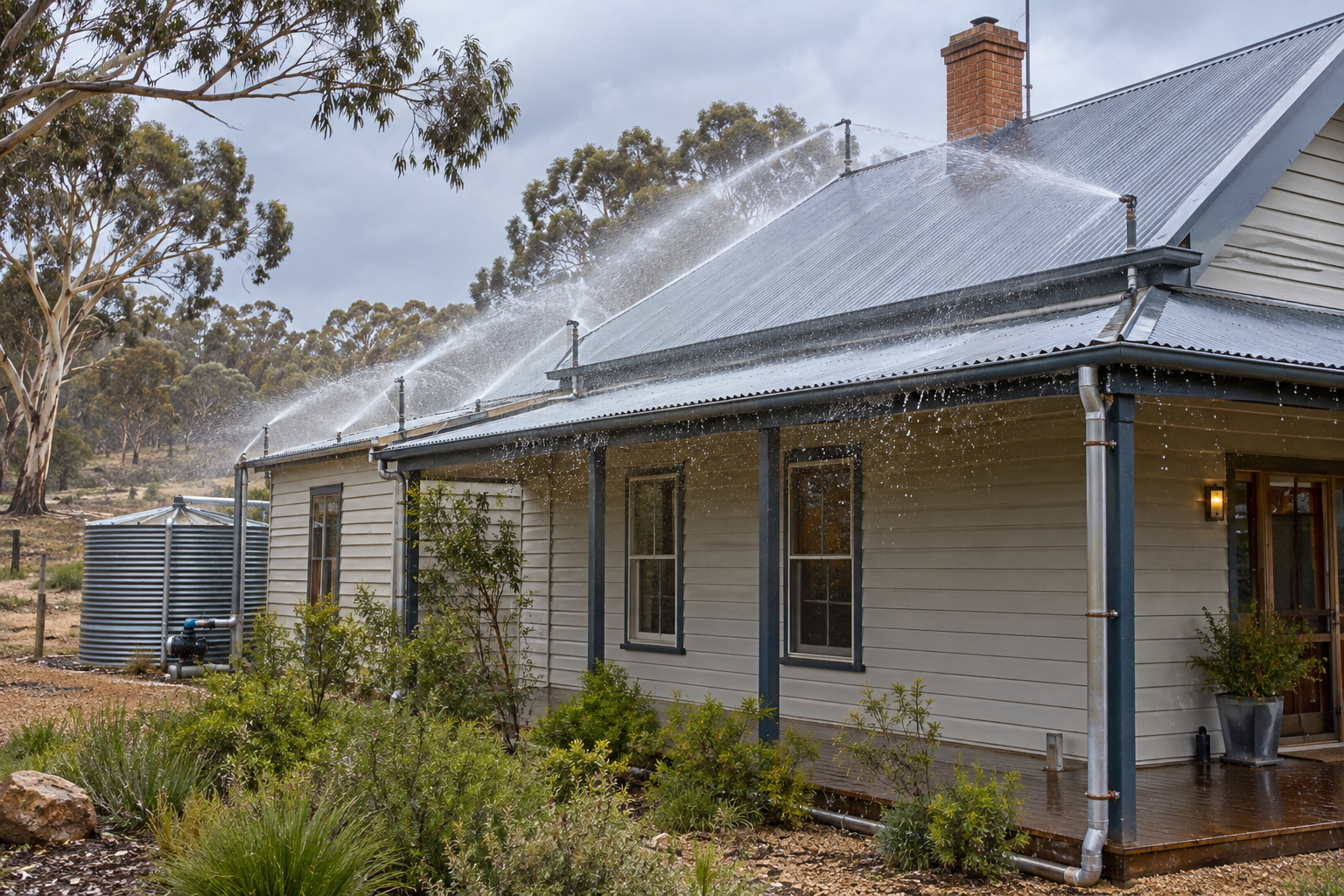
The reality is more precise, and once you understand it, your buying decisions become much clearer. An exterior bushfire sprinkler system is designed to wet down the surfaces of your home and its immediate surrounds so that ember attack and radiant heat cannot ignite the structure as a fire front passes through. It does not extinguish the fire itself. That distinction matters enormously when you are specifying a system for your property.
In this guide, you will learn exactly how these systems work, what threats they are built to address, what they cannot protect against, and where they fit within BAL zone requirements under Australian Standard 3959. You will also learn what to confirm before requesting a quote, so that when you do move forward, you are investing in a system matched to your actual risk level, not a general assumption about what bushfire protection looks like.
What a Bushfire Sprinkler System Actually Does
An exterior bushfire sprinkler system does one specific job: it keeps a building wet. Nozzles saturate the roof, gutters, eaves, and wall surfaces so that ember attack and radiant heat cannot raise those surfaces to ignition point during fire front passage. This is fundamentally different from fire suppression. The system does not extinguish flames; it removes the conditions that allow ignition to take hold in the first place.
That distinction matters more than most buyers initially realise. CSIRO research confirms that the majority of homes destroyed in bushfires are lost without ever experiencing direct flame contact. Burning embers carried ahead of the fire front land on rooflines, collect in gutters, and settle against combustible cladding. The structure can begin to ignite well before any flame makes direct contact.
This means the real protection problem is ignition prevention, not flame suppression. A system designed around wetting logic addresses exactly that problem. One designed around suppression assumptions would require an entirely different scale of water delivery and infrastructure.
Getting this right at the specification stage has direct practical consequences. A buyer expecting full fire suppression will under-invest in the site preparation and vegetation management that make a sprinkler system effective, and may also under-size the water supply.
FireReady's Exterior Sprinkler Systems are designed around this wetting principle, with coverage targeting the surfaces and zones where ember accumulation and radiant heat exposure pose the greatest ignition risk.
The Two Threats a Bushfire Sprinkler System Is Built to Address
Two distinct threats drive the design of every exterior bushfire sprinkler system: ember attack and radiant heat.
Ember attack occurs when burning embers are carried by wind ahead of a fire front, sometimes travelling significant distances before landing on roofs, collecting in gutters, settling against wall cladding, or dropping into dry leaf litter. Research into recent destructive Australian bushfires indicates ember attack is responsible for the majority of residential structure losses, not direct flame contact. A consistently wetted surface keeps airborne embers from taking hold.
Radiant heat is the second threat. As a fire front approaches, intense heat radiates outward and can raise the temperature of exposed exterior surfaces to ignition point without any flame making contact. NEMA confirms radiant heat is a significant and distinct protection consideration. A saturated surface absorbs and dissipates that heat load rather than responding to it with ignition.
A third threat, direct flame impingement, also exists but sits outside the design scope of a wetting system. If flames make sustained, close-range contact with the structure, wetting alone cannot guarantee protection. Understanding this boundary before selecting a system is essential.
Identifying which threat is most relevant to your property's exposure directly shapes nozzle placement, required flow rates, and the priority coverage zones in any system design.
How an Exterior Bushfire Sprinkler System Works: Components and Coverage
Addressing those two threats requires the right hardware, correctly configured. A typical exterior bushfire sprinkler system has four core components: roof-mounted or eave-mounted nozzles, a dedicated water supply line, a pump or header tank, and an activation mechanism that is manual, automatic, or both.
Nozzle placement is the critical design decision. Nozzles must deliver even wetting across the surfaces where embers lodge first, roofing material, gutters, fascias, and wall cladding. Gaps in coverage leave ignition pathways that undermine the whole system.
Coverage design must also account for roof pitch, building footprint, and the prevailing wind direction relative to the most likely fire approach corridor. A flat-roofed cottage and a steeply pitched homestead present completely different wetting challenges, and a system sized for one will not perform adequately on the other.
Water delivery is continuous during activation, not intermittent. The objective is a persistently saturated surface for the full duration of fire front passage, which can vary considerably in duration depending on conditions.
Automatic bushfire sprinkler systems add a significant safety margin by removing the need for someone to be present and calm enough to activate the system manually. Heat sensors or integration with fire weather alert signals can trigger the system without human input, which matters enormously when evacuation decisions are being made under pressure.
If you are assessing options for your property, Protect Your Home This Fire Season outlines what a correctly specified installation involves.
Automatic vs. Manual Activation: Which Is Right for Your Property
Activation type is as important a design decision as nozzle placement or water supply.
Manual activation requires the owner or a designated person to be on-site and physically start the system. This is workable for properties that are consistently occupied during fire season, but the risk is plain: if evacuation is delayed or conditions deteriorate faster than expected, the system may never get switched on.
Automatic bushfire sprinkler systems remove that dependency entirely. Using heat sensors, smoke detection, or remote triggers, they activate without human intervention. This matters most for:
Holiday properties left unoccupied during summer
Rural holdings without continuous staff presence
High-BAL zone properties where fast-moving fire fronts leave little response time
The right choice comes down to three factors: how consistently your property is occupied during fire season, the fire weather profile of your region, and your BAL rating. Higher risk on any of these axes generally favours automatic activation.
Many installations now combine both. A timed automatic trigger fires the system if conditions are met, while a manual override lets occupants control it directly when present. This hybrid approach provides a sensible fallback regardless of whether the property is attended.
One point applies equally to every activation type: the system must be tested and confirmed operational before fire season begins. An automatic system with a failed pump or blocked nozzles offers no protection at all, regardless of how well it was originally specified.
Water Supply: What Your System Needs to Function When It Matters
Activation type only matters if the system actually runs when needed. That depends entirely on water supply.
Mains pressure may not be reliable during a fire event, making a dedicated tank and pump the standard recommendation for rural and semi-rural properties.
Tank sizing involves three variables: the total surface area to be wetted, the system's designed flow rate in litres per minute, and the expected duration of fire front passage for your region. A supplier can model the right tank volume for your specific property once those parameters are known. Guessing undersizes the system.
Mains power can fail during fire events. For higher-BAL properties, consult your installer about power-independent pump options.
Water supply planning is where many property owners get caught out. It is easy to focus on nozzle layout and activation type and leave supply as an afterthought, only to face expensive rectification after installation. Before committing to any system, confirm your tank capacity and pump specification alongside the nozzle design. The Protect Your Home This Fire Season page outlines what a full system assessment covers.
BAL Zones and System Suitability: Where Sprinklers Fit and Where They Have Limits
Knowing your water supply capacity matters, but it only becomes relevant once you've confirmed a sprinkler system is the right tool for your property's risk level. That determination comes from your Bushfire Attack Level rating.
Australia's BAL framework classifies properties by the likely intensity of bushfire attack, reflecting measurable increases in radiant heat flux and ember intensity across its rating levels.
The CFA retrofit guide sets a clear boundary: exterior sprinkler system recommendations apply to properties up to BAL 29. Properties rated BAL 40 or BAL FZ are classified as very high to extreme risk, and are generally not suitable for retrofit upgrades alone. A sprinkler system at these risk levels is not an adequate response.
For BAL 40 and BAL FZ properties, construction-level hardening and specialist fire engineering assessment are required; a wetting system alone is not an adequate response.
If you do not yet know your BAL rating, a formal assessment is the necessary first step. It determines which protection measures are applicable, how they should be sized, and whether they meet relevant standards.
Retrofitting is not mandatory in Victoria, but for properties rated BAL 12.5 through BAL 29, a correctly specified exterior bushfire sprinkler system materially improves survival prospects during fire front passage, provided it is combined with broader site preparation measures.
What an Exterior Sprinkler System Does Not Protect Against
Even a correctly specified system has boundaries that every property owner should understand before relying on it.
Direct flame impingement occurs when vegetation immediately adjacent to the structure ignites and produces sustained, close-range flame contact. Wetting reduces surface temperatures, but it cannot absorb unlimited radiant and convective energy from adjacent burning vegetation, which is why defendable space is not optional.
Internal ignition is outside the system's reach entirely. An exterior bushfire sprinkler system wets external surfaces; it has no effect on embers that enter through subfloor vents, roof cavities, gaps under doors, or damaged eaves. Sealing these penetrations is a separate, essential measure.
Prolonged fire events test the limits of any finite water supply. These systems are designed for fire front passage, which typically lasts minutes to roughly an hour. If conditions persist well beyond that window, or if the water supply is exhausted before the fire moves on, the protection window closes.
Structural inadequacies create ignition pathways that wetting cannot fully offset. Cracked cladding, exposed timber framing, and degraded gutters remain vulnerable regardless of how well the nozzles are performing.
None of these limitations argue against installation. They are, in fact, exactly why the CFA and CSIRO consistently describe exterior sprinkler systems as one layer within a multi-process protection strategy. Understanding the boundaries is what allows you to build the other layers correctly around it.
Sprinklers Are One Layer: How They Fit Into a Complete Bushfire Protection Strategy
Those limits point directly to a core principle: a sprinkler system performs best when it is not working alone.
CFA guidance frames effective bushfire protection as a multi-layered strategy that combines site vegetation management, defendable space maintenance, active protection equipment such as sprinkler systems, and construction safety measures. The sprinkler system occupies the active equipment layer. It delivers the most value when the vegetation and site layers have already reduced the threat load it must handle.
A property with heavy fuel accumulation adjacent to the structure, uncleared gutters, and no established fire break forces a sprinkler system to compensate for preparation gaps it was never designed to close. System performance and site preparation are directly interdependent.
Get Fire Ready is home to GFR Property Services, which addresses these other protection layers through services including excavator clearing of undergrowth and fire fuels, fire break creation, defendable space preparation, gutter cleaning, and broader vegetation management. Each service reduces the ignition risk that a sprinkler system would otherwise face alone.
This is the approach both CFA guidance and survival research consistently support. It is also the approach FireReady brings to every property assessment: identifying which layers are in place, which are not, and what combination of preparation and active equipment gives the structure its best realistic chance.
Before You Request a Quote: What to Confirm First
Before requesting a quote, work through these four checks in order.
Know your BAL rating first. A formal BAL assessment is the necessary first step, if the result is BAL 40 or BAL FZ, seek specialist fire engineering advice before specifying any system.
Audit your water and power supply honestly. A correctly specified system that runs dry before the fire front passes provides false confidence rather than real protection. Confirm your tank capacity, pump output, and whether your power source is reliable during a fire event. Mains power can fail; discuss power-independent pump options with your installer for higher-BAL properties.
Match your activation type to your occupancy and regional fire profile, automatic systems are the safer default for unattended or high-risk properties.
Check your site preparation status. Gutters, defendable space, and vegetation management should be addressed alongside or before installation. A sprinkler system working against uncleared fuel loads and blocked gutters is working at a serious disadvantage.
Once these four factors are clear, contact FireReady to discuss your property's specific conditions. Combining a correctly specified exterior bushfire sprinkler system with thorough site preparation gives your property the best realistic chance of surviving fire front passage intact.
Conclusion
An exterior bushfire sprinkler system is a proven, practical layer of protection, but only when it is correctly specified, adequately supplied, and integrated into a broader fire strategy. The core lessons from this guide are straightforward: understand what sprinklers actually defend against, confirm your BAL rating before specifying anything, ensure your water and power supply can perform under real fire conditions, and pair your system with solid site preparation.
No single measure makes a property fireproof. What a well-designed exterior system does is significantly improve your odds during the most dangerous window: fire front passage and ember attack.
If you are ready to move forward, contact FireReady for an assessment tailored to your property's specific conditions and risk profile. The right system, properly installed and supported, is one of the most meaningful investments a property owner can make before fire season arrives.